The year 1976, being just fifty years ago, is extremely recent in archival terms, but is distant enough in time to feel in many ways quite different to the present-day. This month, we look back at some of the events, concerns and preoccupations which dominated this year at the Inn.
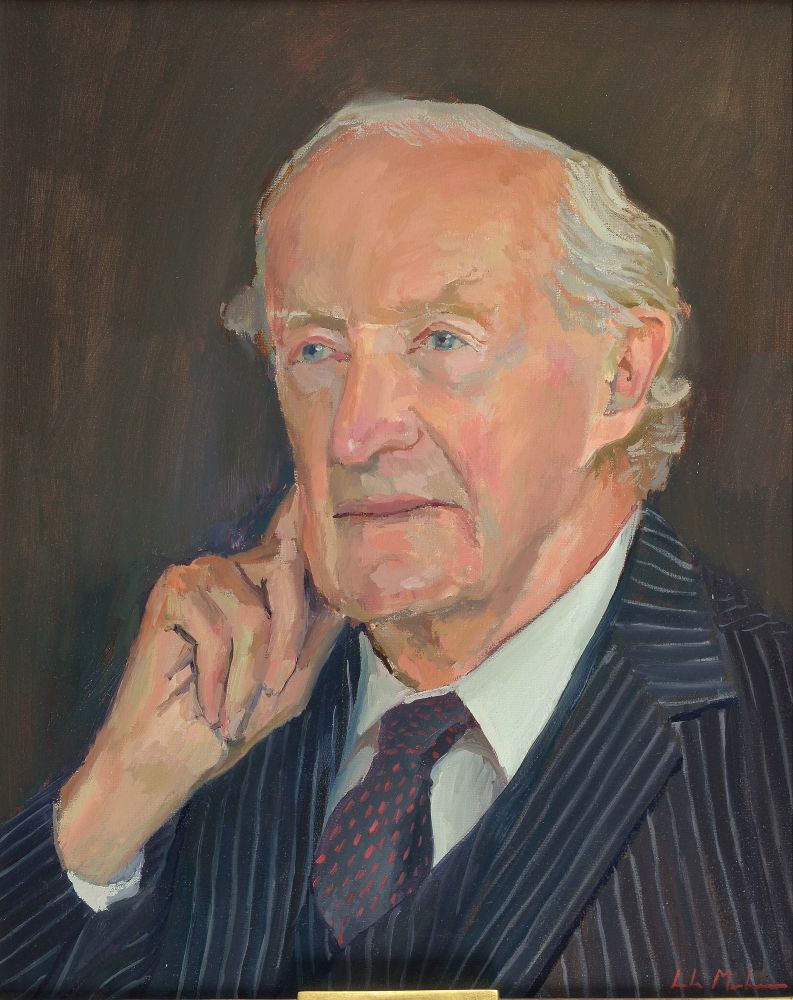
Portrait of Lord Wilberforce, Autumn Reader 1976, painted by Luke Martineau, 2001
The high demand for professional chambers dominated discourse at the Middle Temple during the 1970s. Increasing numbers were seeking to enter the Bar as a profession, and the volume of work demanded of the Bar was growing as a result of new legislation, the expansion of legal aid and the modernisation of the courts. This led to a shortfall in the amount of professional accommodation available at the Middle Temple, which ‘would lead to a failure of the Bar to expand to meet the needs of the administration of justice’. Accordingly, it was decided that residential accommodation, which consisted of just under 50% of the Inn’s capacity in 1973, would be converted to professional chambers when it fell vacant. Benchers were keen that the character of the Inn be preserved as an area with mixed professional and residential accommodation, and it was determined that the residential chambers should take up no less than 25% of the total chambers available across the Inn.
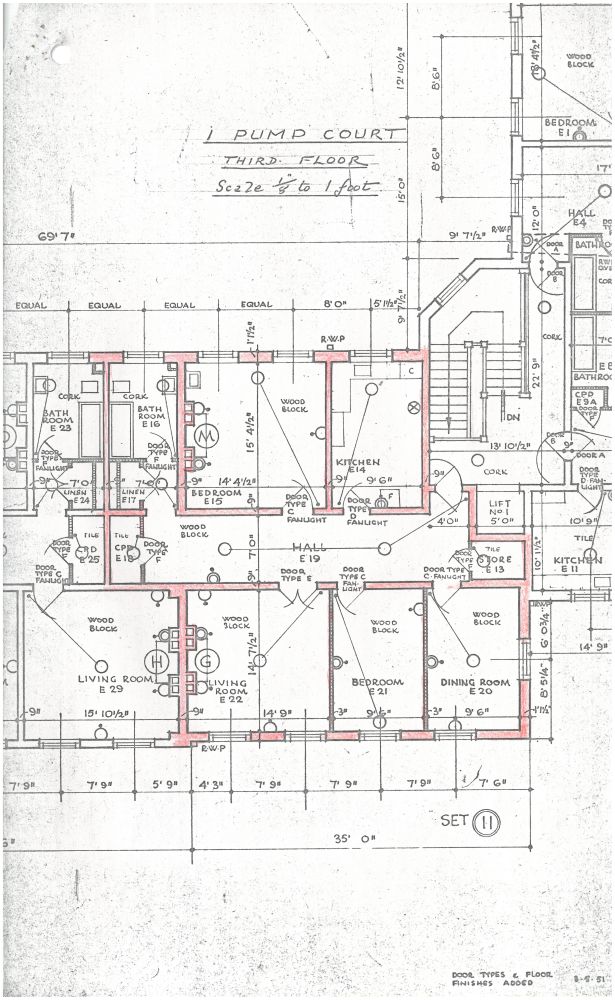
Plan of the third floor of 1 Pump Court prior to conversion, submitted with an application for change of use from residential to professional use, 13 July 1973 (MT/5/ESF/9)
Within the popular consciousness, the 1970s are notorious for their catastrophic economic conditions. The 1973 oil crisis had led to severe inflation which culminated in severe inflation and culminated in an IMF bailout for the UK in September 1976. The inflationary crisis impacted the finances of the Inn, leading to cutbacks in expenditure and the increase of rents by 10% to 15%. One areas where economies were evident was in the catering provision provided to members and Benchers. The quantity and size of dinners offered decreased, charges were raised, and Benchers had to contend not only with a decrease in the quality of wine served, but also the cessation of the provision of cake.
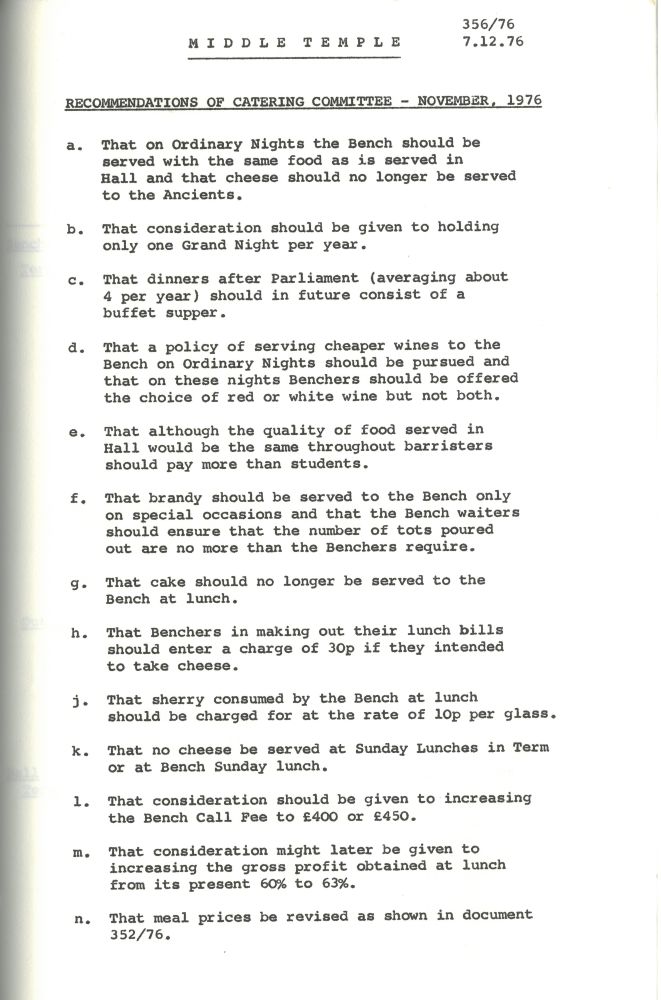
Recommendations of the Catering Committee, November 1976 (MT/1/CFM/8)
While many reductions and economies were made to the Inn’s finances, several acquisitions of new items in the historic collections were made in the form of donations. These included a silver kangaroo, donated by Master Windeyer as a symbol of Australia’s inheritance of the law from England; a portrait of Sybil Campbell, the first woman to be appointed as a stipendiary magistrate in Britain; a Regency drum table that currently furnishes the Prince’s Room, which was purchased with part of a bequest from Master Mackinnon; and the majority of the portraits of Prime Ministers currently hanging in the Library, donated by a member, Mr M. Philips.
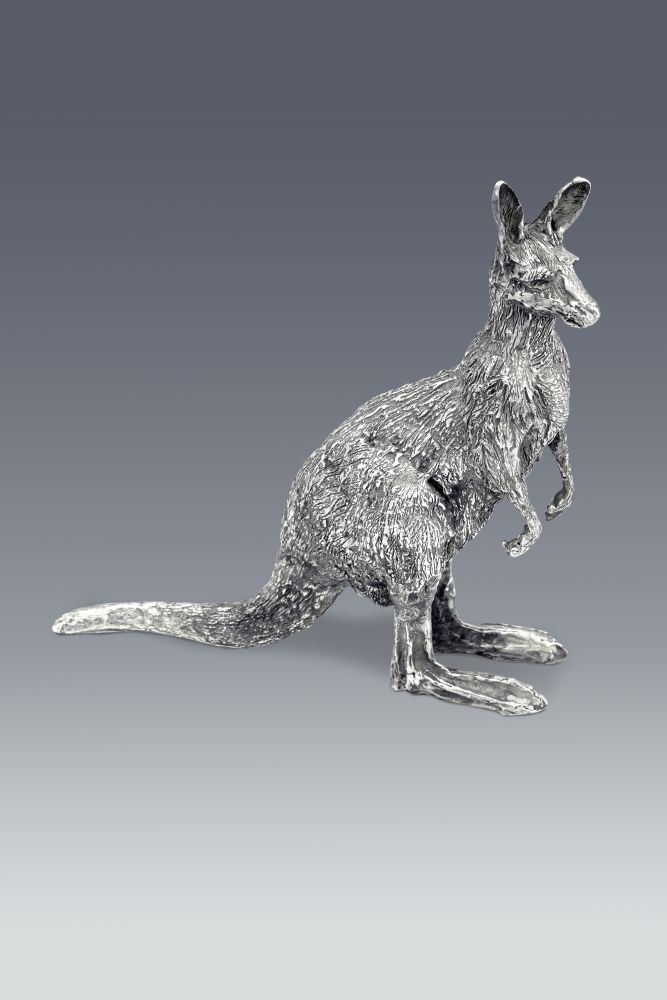
Silver kangaroo, donated by Master Windeyer in 1976
The Middle Temple’s growing collections were endangered by the surge in urban crime and gang violence in 1970s London. The Inns of Court were among the victims of this crime increase and were targeted, along with other places in the City of London, for their clocks. A clock was stolen from the Inn’s Parliament Chamber, Inner Temple had two clocks taken and Lincoln’s Inn was robbed of a large grandfather clock – the size of the stolen object showing more than mere opportunism was at play. A notice from the City of London Police indicates that by September, thirty crimes had been reported that year as having occurred in the Temple, most of these being in the form of a ‘Walk-In-Thief’, with the total loss being nine carriage clocks, nine calculators, five dictating machines and other easily stolen items such as wallets and handbags.
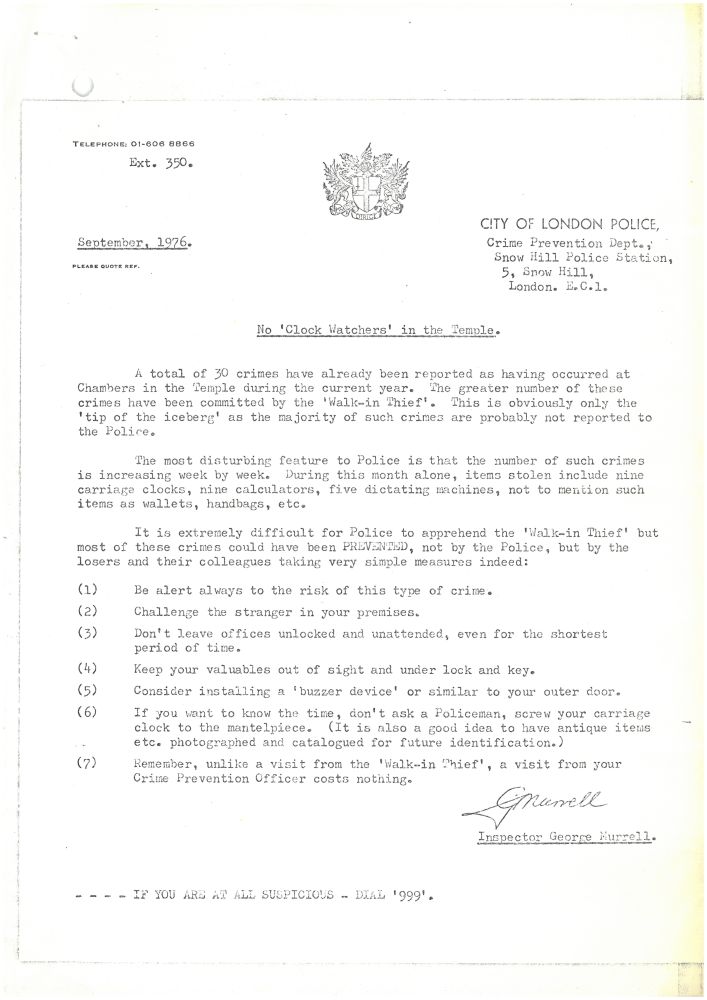
A notice from the City of London Police regarding thefts in the Temple, September 1976 (MT/5/ESY/3)
Another more serious security issue during the year was caused by the terror campaign by the IRA in London. The previous year there had been seventeen terror attacks, mostly consisting of bombings, killing some and injuring scores more. From January to March 1976, there were a further seven terror attacks in London, leading to a pervasive sense of unease in the capital. Security was tightened at the Inn, scrutiny over parking and vehicle entry was increased and the gates were shut for longer periods. Members who used the library were instructed not to leave unattended bags or cases anywhere due to the ongoing threat of bomb attacks.
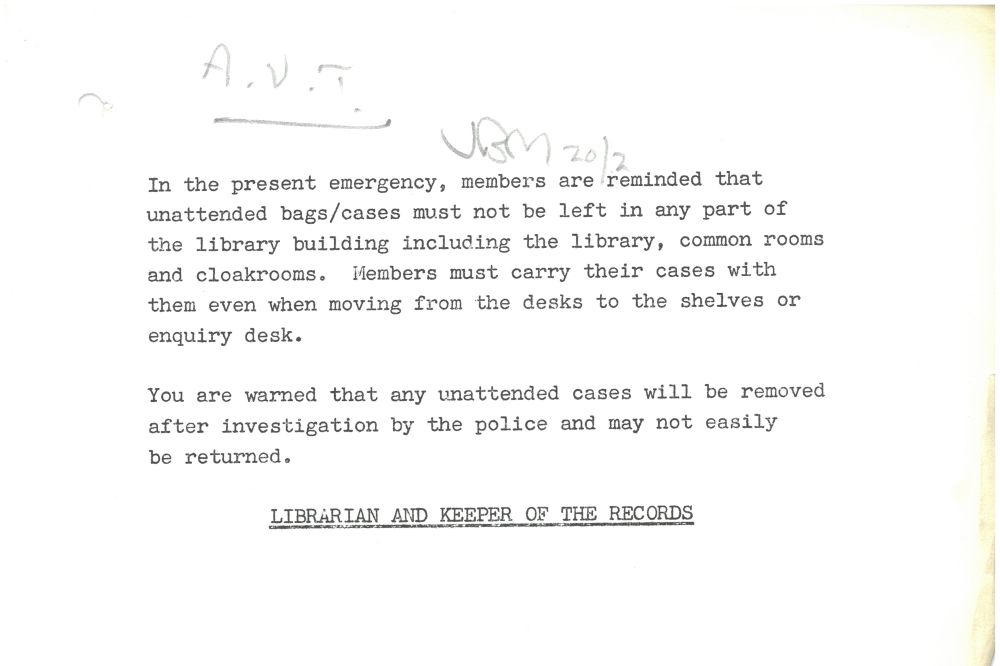
Notice reminding members of the Inn not to leave unattended bags and cases in any part of the Library building due to IRA attacks in London, c.1976 (MT/5/ESY)
On 6 May, the US Ambassador Anne Armstrong was made the Inn’s first female Honorary Bencher - the only female Bencher apart from the Queen Mother until the first ordinary Bencher, Dame Margaret Booth, was Called in 1979. Ambassador Armstrong was appointed to her post on 14 January 1976, coinciding with the bicentenary year of the adoption of the Declaration of Independence on the 4 July 1776. On the day of her call, a short ceremony was held in Hall in the presence of the dining barristers and students before the Benchers retired from the Hall for port and dessert in private. Master Armstrong then undertook the traditional duties of ‘Master Junior’ and was asked to give a short ten-minute speech. On 3 June, she wrote to Treasurer thanking him for ‘one of the most impressive and delightful evenings I have ever enjoyed’.
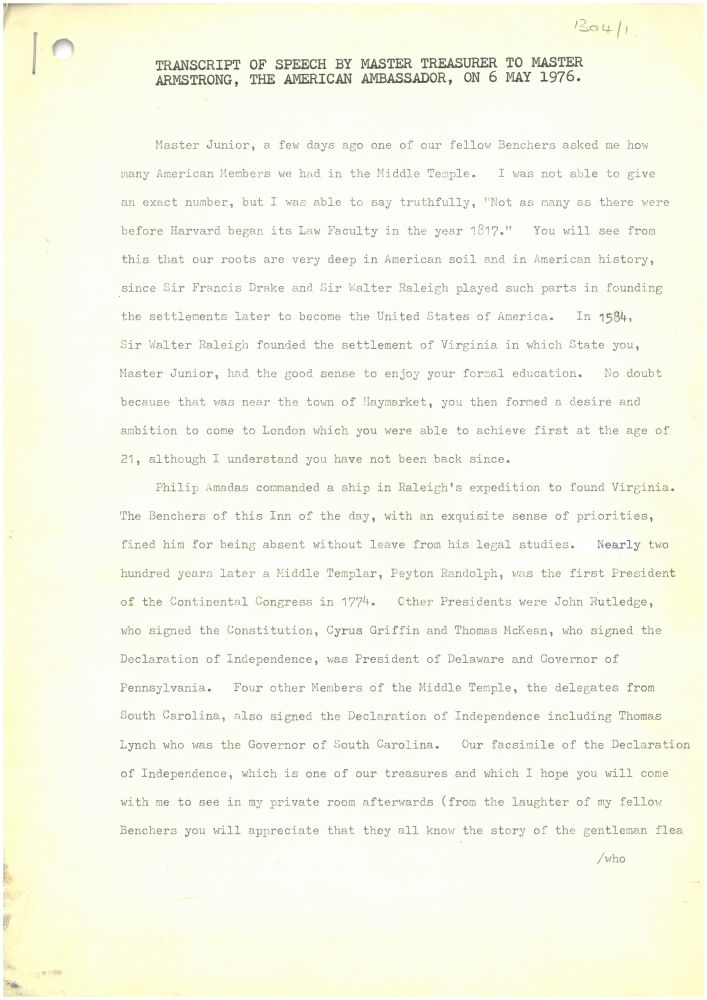
Treasurer’s speech on the Call to the Bench of Anne Armstrong, 6 May 1976 (MT/3/BEM/42)
At the beginning of Michaelmas Term, after a long drought-filled summer, the centenary of the re-introduction of the Ancients’ Table was celebrated with a special dinner accompanied by fine wine. This table, now no longer used in Hall, was reserved for the eight most senior barristers dining. They had their own set of traditions, such as the privilege to be invited to take port and dessert with the Bencher dining if only one was present. By 1976 there was the feeling that some Ancients were taking ‘undue advantage’ of this privilege and to prevent a single Bencher being kept late on a Friday, it was mandated that two duty Benchers be required to dine on Friday nights. Several items from the Inn’s historic collection of silver were donated in the early twentieth century for the use of the Ancients’ Table and it survived as part of the Inn’s dining traditions into the new millennium.
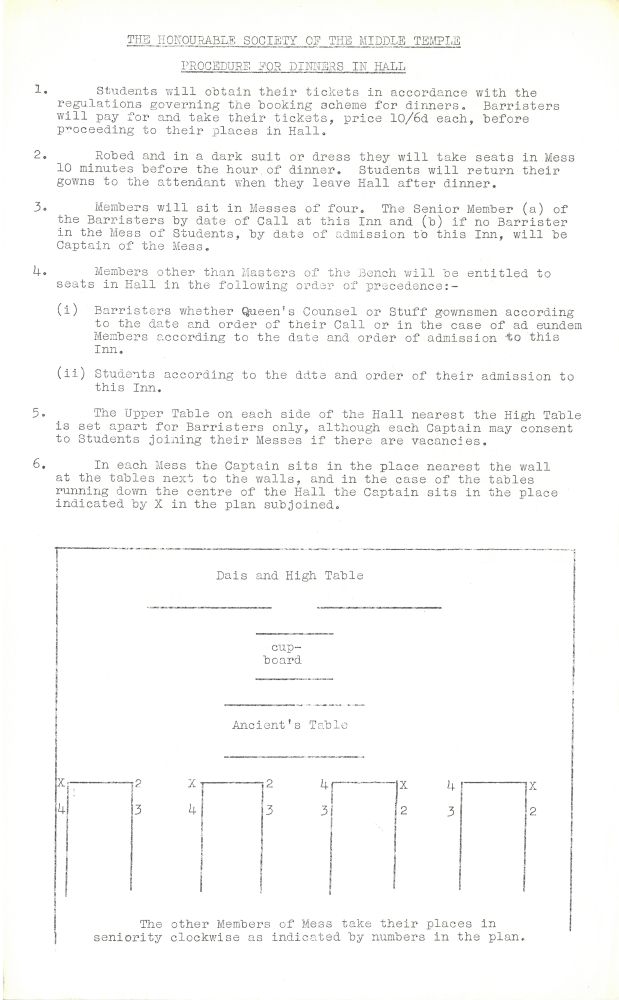
‘Procedure for Dinners in Hall’ showing the position of the Ancients’ Table, c.1970 (MT/7/DTF/1)
While the Middle Temple hosted many routine and decorous dinners and events throughout the year, they also suffered through a ball held by the notorious Bullingdon Club. This is a private all-male dining club based at the University of Oxford, known for its wealthy members and infamous for its violent, vandalistic tendencies. Despite its notoriety, the Club boasts notable past members, including the former Prime Ministers (and Honorary Benchers) David Cameron and Boris Johnson. Warning bells sounded early in the Daily Express on 23 June, which reported ‘it comes as some surprise to learn that the Bullingdon Club, a homeless group of imbibers… has chosen the hallowed premises of the Middle Temple for their next binge’. The article went on to explain that the club’s last major gathering had been in the 1950s at Christ Church, Oxford, where ‘everyone of the quad’s 500 windows were broken’ and they were ‘banned permanently from convening thereafter within a 15 mile radius of Oxford’. However, the Ball Chairman assured the Inn of ‘impeccable behaviour’ and the Under Treasurer gave them the benefit of the doubt.
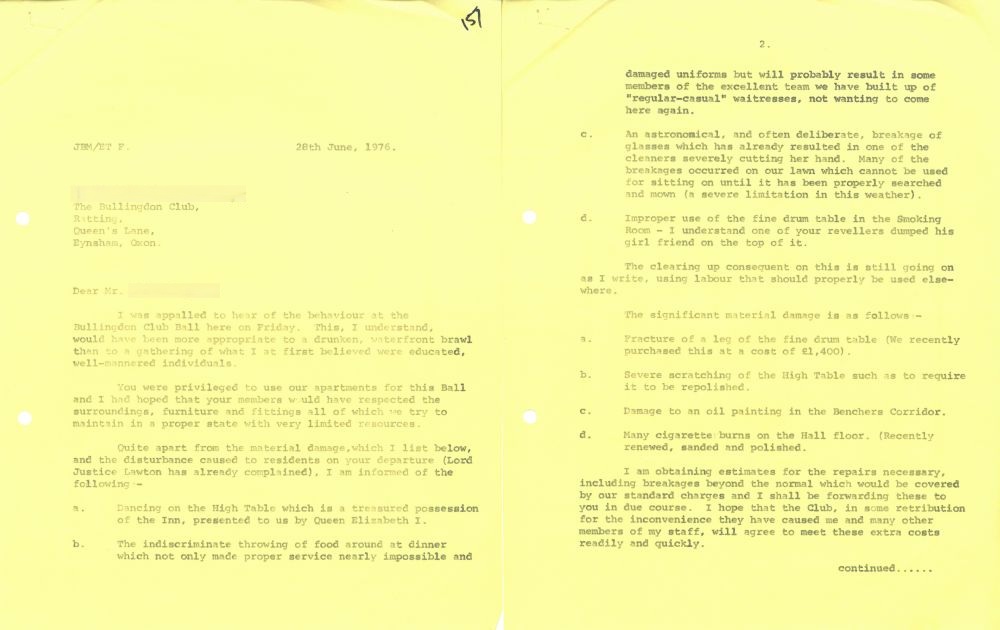
Letter from the Under Treasurer to the Bullingdon Club after a disastrous ball, 28 June 1976 (MT/1/LBO/163)
The ball was a disaster. The Under Treasurer wrote a letter in the aftermath to the club complaining that the event had ‘been more appropriate to a drunken, waterfront brawl than to a gathering of what I at first believed were educated, well-mannered individuals’. The appalling behaviour and damage included dancing on High Table causing severe scratching, throwing food around indiscriminately, ‘astronomical, and often deliberate, breakage of glasses’, which resulted in a cleaner being injured and rendered the lawn unusable for a time, damage to the new drum table in the Prince’s Room when one of the revellers dumped his girlfriend on top of it, damage to a painting and cigarette burns all over the newly renewed wood floor in the Hall. As a result of this event, the Club was banned from the Middle Temple and scrutiny over the booking of similar functions was increased.
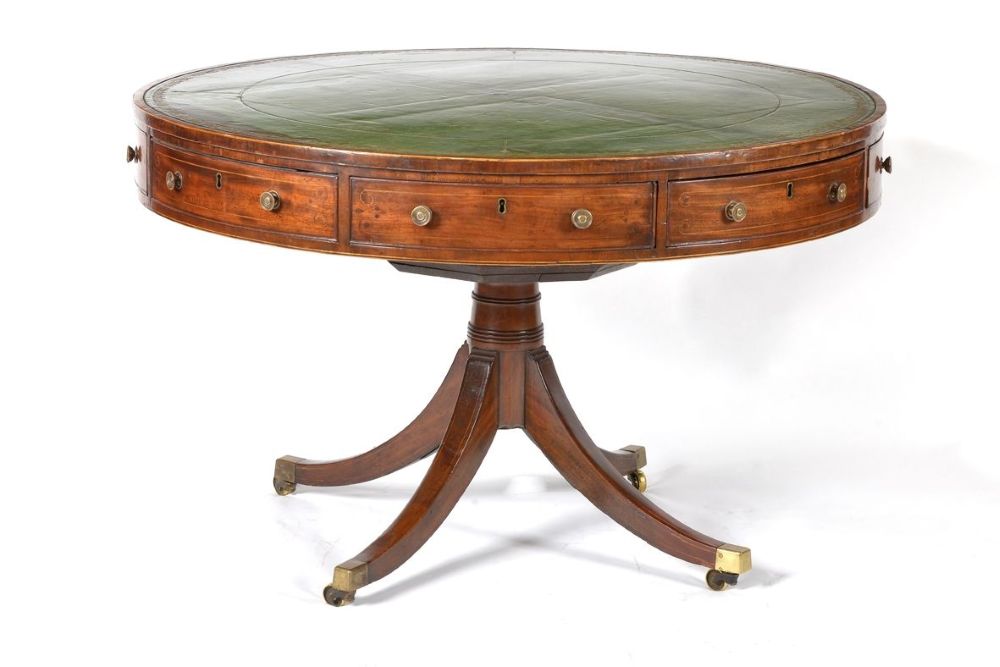
Regency drum table purchased with a bequest from Master Mackinnon
A more sedate affair was held in the presence of the Queen Mother, the Inn’s Royal Bencher at the time, who was invited annually to a small Family Dinner held in the Parliament Chamber with her fellow Benchers. She duly accepted the usual invitation and arrived for dinner on Thursday 9 December. After her arrival, members of staff were presented to her, then the ex-Treasurers and finally new Benchers. She was sat at dinner with the Treasurer on her left and the Deputy Treasurer on her right and was served a five-course meal with coffee afterwards and one hundred-year-old brandy. The day afterwards the Treasurer sent a letter to Her Majesty thanking her for ‘her radiance, kindness and interest in the Domus’ and hoped that she ‘enjoyed herself and that her lovely necklace has survived my inexpert attention’. The Comptroller to the Queen Mother replied stating that ‘it was a particularly happy evening and one which Her Majesty will long remember’.
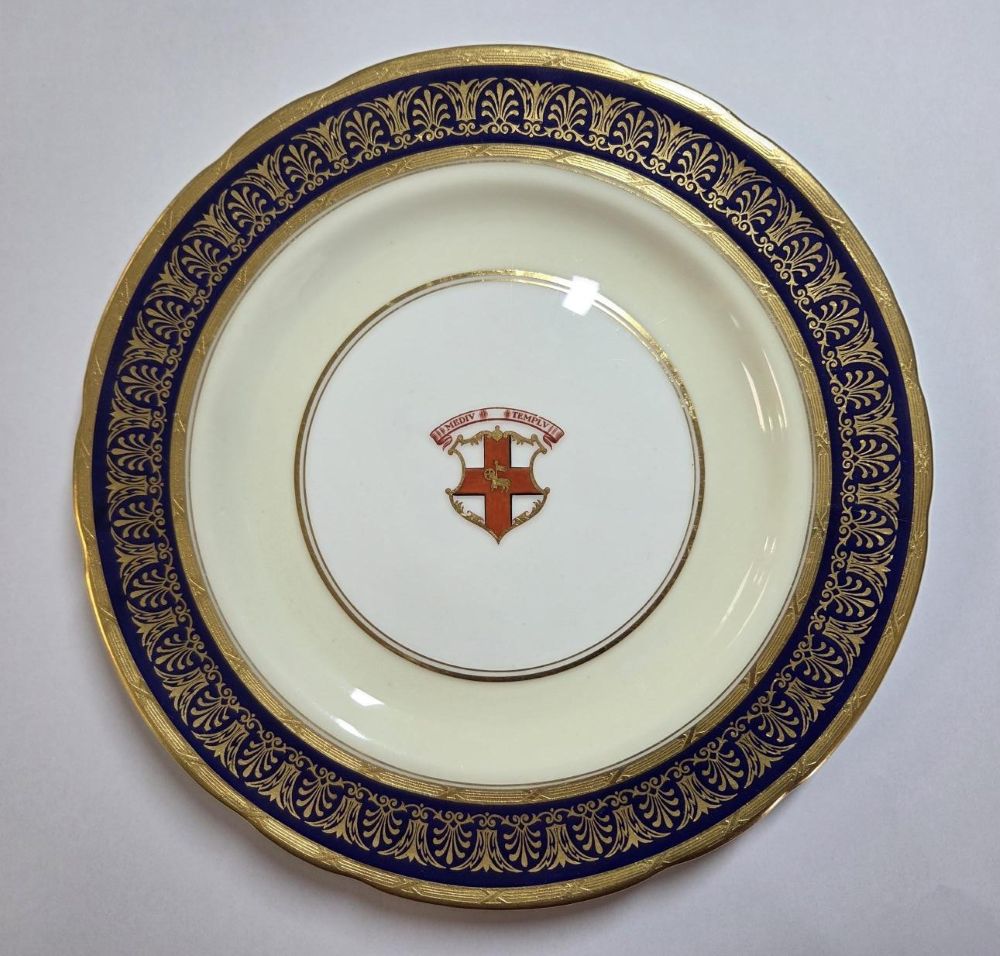
Part of an eighty-three-piece Minton bone china part Dinner Service, c.1900, reportedly used on occasions that Queen Elizabeth, the Queen Mother dined at the Inn
The year made its exit with the traditional Middle Temple Revels. The Treasurer, Sir George Baker, was gently herded into performing in the Revels. An offhand comment he made, according to his account, saying ‘the Treasurer was willing to make an ass of himself in the line of duty’ was taken as interest in performing. One of the organisers doggedly followed up with him and allotted him 10 minutes to perform. There was a further appeal for him to persuade fellow Benchers to join in as contributors, with a special request for one that had an aptitude for ballroom dancing. Sir George, requiring only gentle pressing, accepted his ten-minute slot and proposed ‘Sermons by the Very Irreverend Angus McSporran’, and requested help ‘from a female who can say one sentence in broad Scots’.
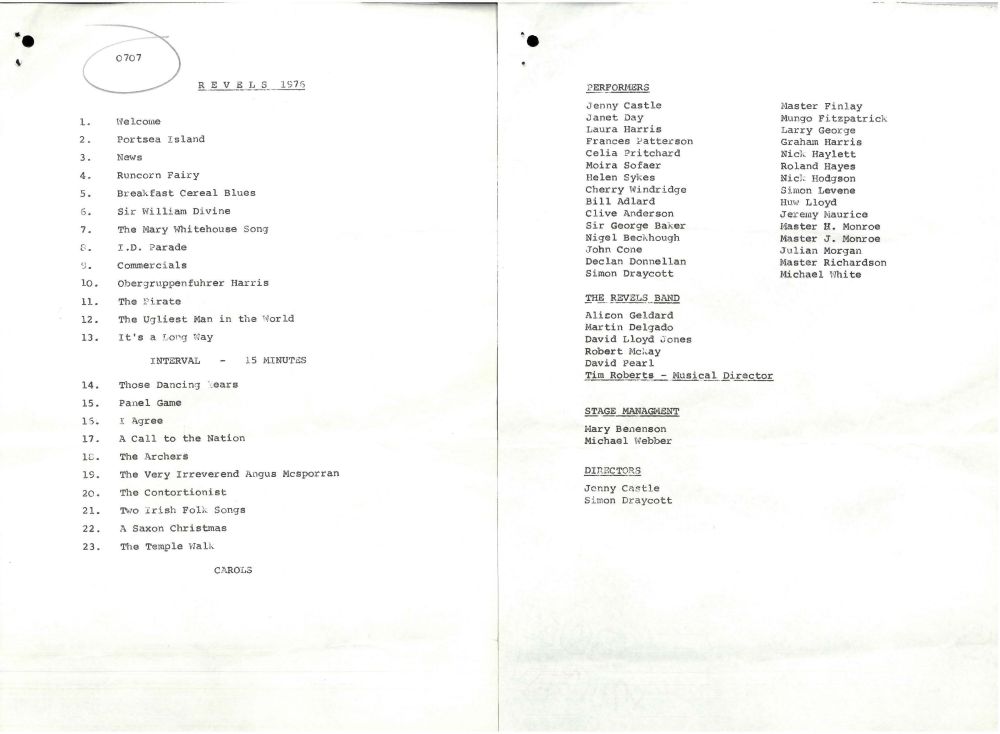
Programme for the 1976 Revels (MT/7/REV/19)
While the Middle Temple of fifty years ago may feel unfamiliar or even alien to some younger members, 1976 is nonetheless within the living memory of many. It is hoped that this review of some of the highlights of that year might have proved of interest to the former, and sparked recollections or indeed nostalgia in the latter.
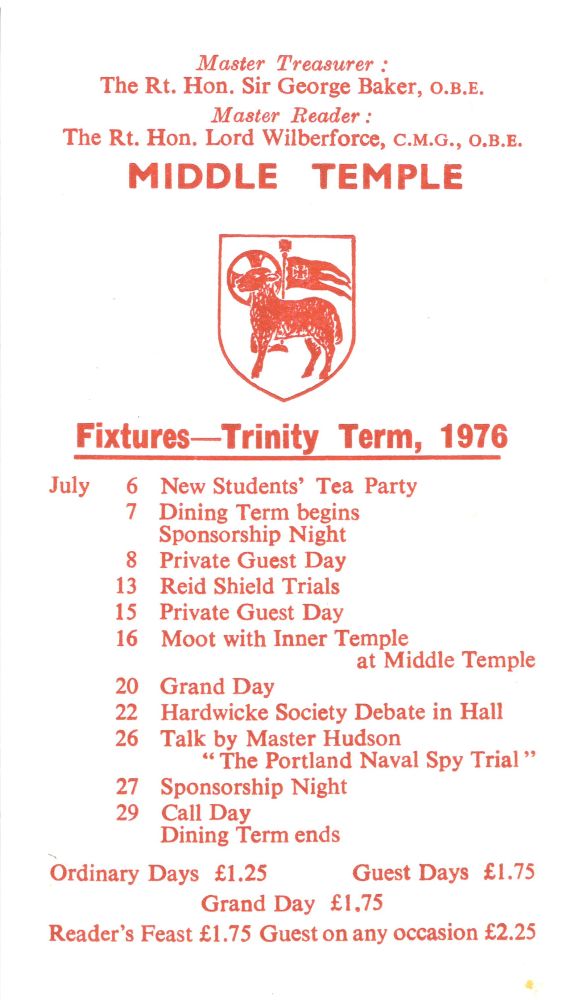
Fixture list for Trinity Term, 1976 (MT/7/DTF/2)