Please note: This article includes material and themes which relate to cultural appropriation, colonialism and enslavement. Related contemporary terminology appears in this article but it is made clear throughout that these are quotations which do not reflect present-day usage or opinion.
This year marks the 250th anniversary of the Declaration of American Independence, and in this edition we look back to an occasion many years earlier: the 'Memorable Masque' staged in 1613 by Middle Temple and Lincoln's Inn, an extravagant entertainment with an American theme.
Masques, a popular phenomenon uniting professional talent and amateur enthusiasm, encompassed dancing, singing, music, acting, elaborate costumes and extraordinary scenery, and were often staged for a royal audience. The 'Memorable Masque' was staged at court by the two Inns to celebrate the marriage of Princess Elizabeth, daughter of King James I, to Frederick V, Elector Palatine. The overarching theme was the colony of Virginia in North America, and the moral and political debates which surrounded it.
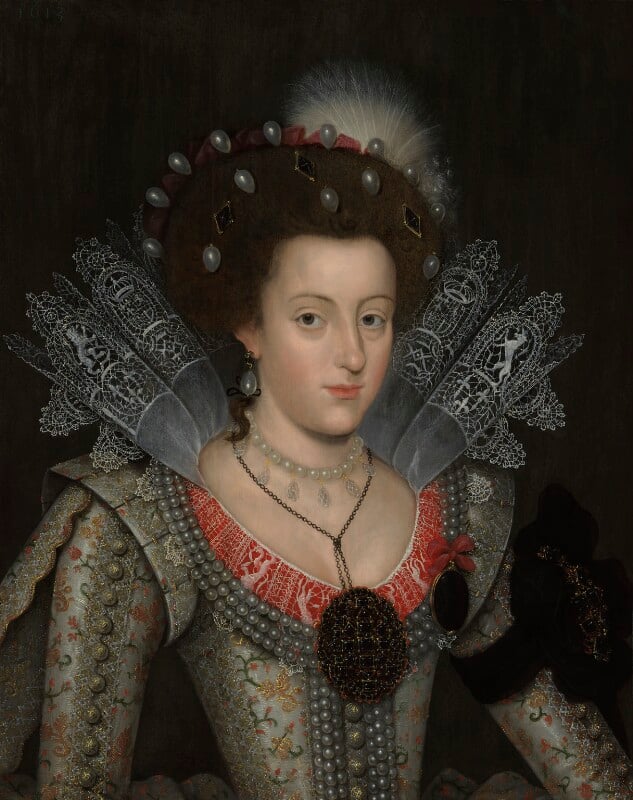
Princess Elizabeth, Queen of Bohemia and Electress Palatine, by Unknown artist, 1613
NPG 5529 © National Portrait Gallery, London
Colonialism in Virginia
The first English settlement in America, organised by Middle Templar Sir Walter Raleigh in 1584, ended in failure, and in 1606, King James chartered the Virginia Company of London to establish a new colony. One of the company's leading backers was the King's eldest son Prince Henry, a popular figure who was more enthused than his father by the perceived commercial opportunities offered by colonisation, and was fervently committed to the conversion of indigenous populations to Protestant Christianity.
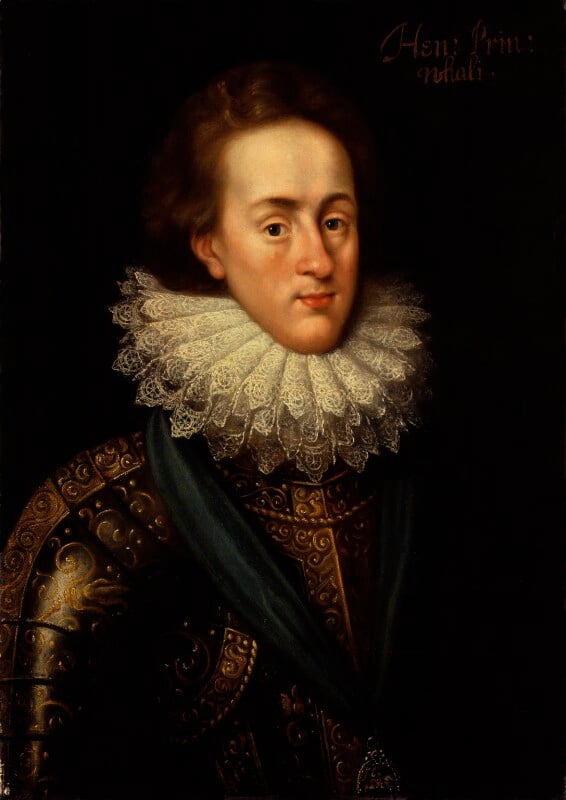
Henry, Prince of Wales, after Isaac Oliver, c1610
NPG 407 © National Portrait Gallery, London
The Middle Temple was a centre of colonial interest at the time, and members of the Inn were among the many Londoners involved and invested in the Virginian project. The explorer and privateer Bartholomew Gosnold, admitted in 1593, heavily promoted the initiative and was pivotal in obtaining the royal charter. He had a decade earlier led an expedition down the east coast of America, naming the island of Martha's Vineyard after his daughter. The Reader of Temple Church, William Crashaw, was also a strong advocate for these efforts, arguing in a 1609 sermon that colonisation was 'not only a lawful, but a most excellent and holy action'.
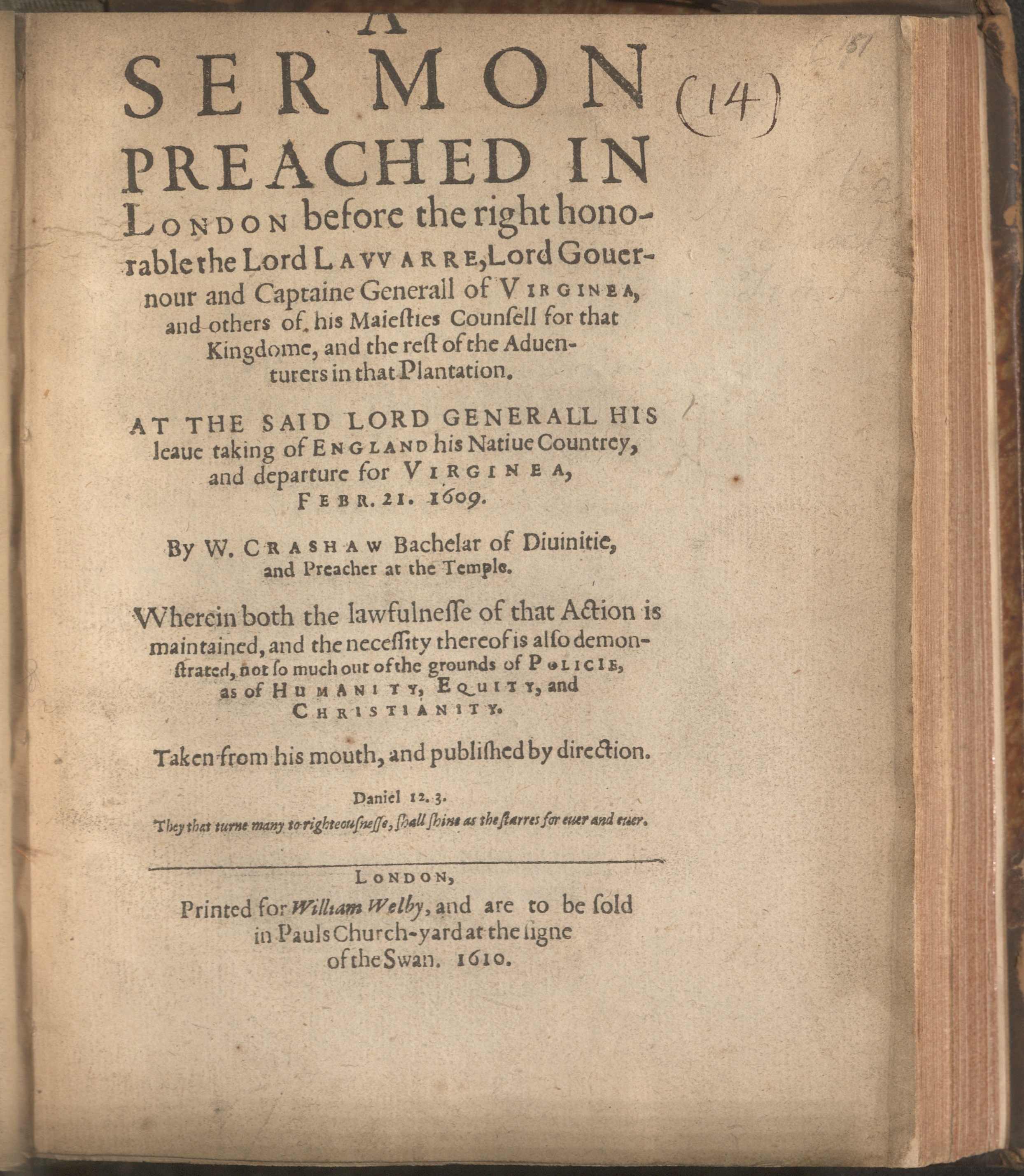
'A Sermon Preached in London before the right honorable the Lord Lavvarre, Lord Gouernor and Captaine Generall of Virginea', by William Crashaw, Reader of the Temple Church, 1610
The first expedition of the Virginia Company sailed in 1607, with Gosnold as vice-admiral, and a colony was established, named Jamestown after the King. The settlement soon met with disaster, with a lack of water and supplies leading to what became known as the 'Starving Time', in the winter of 1609-1610, during which hundreds of colonists died. Confidence in the company began to falter and by 1612 it was in a precarious position, in need of advocacy and renewed enthusiasm both at court and amongst the public.
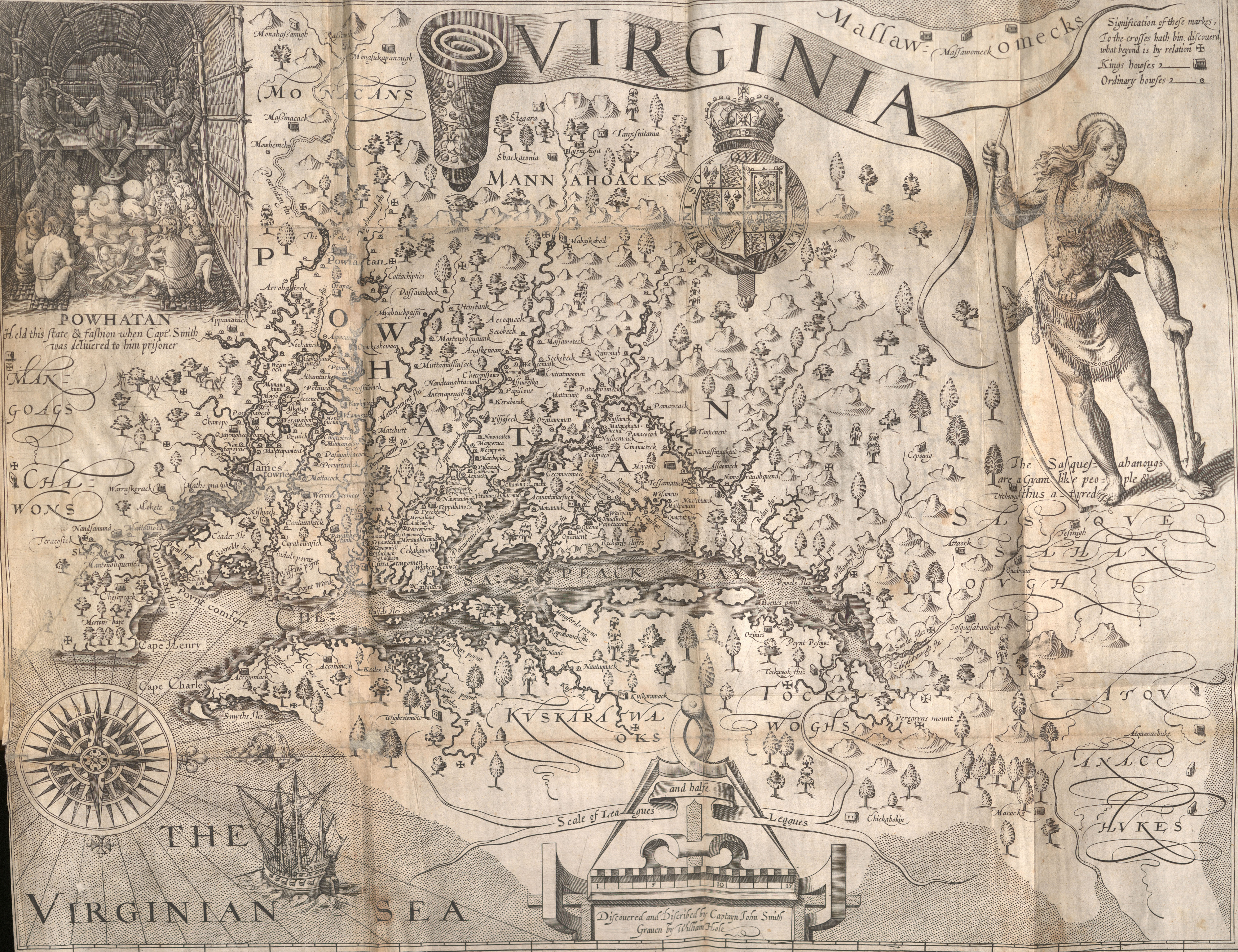
'Virginia, Discovered and Discribed', map attributed to Captain John Smith, 1612
Organisers and Creatives
The men appointed by the two Inns to manage the masque had vested interests in the success of the Virginian enterprise. Sir Edward Phelipps, a Bencher and former Reader of the Inn, had served as Master of the Rolls since 1611 and was Chancellor to Prince Henry. His colleague Richard Martin had, in his youth, been elected 'Prince of Love' at the Inn's Christmas Revels, and was now a barrister, MP and Counsel to the Virginia Company. Both, as well as the two Lincoln's Inn managers - Christopher Brooke and the Attorney General Sir Henry Hobart - were investors in the company.
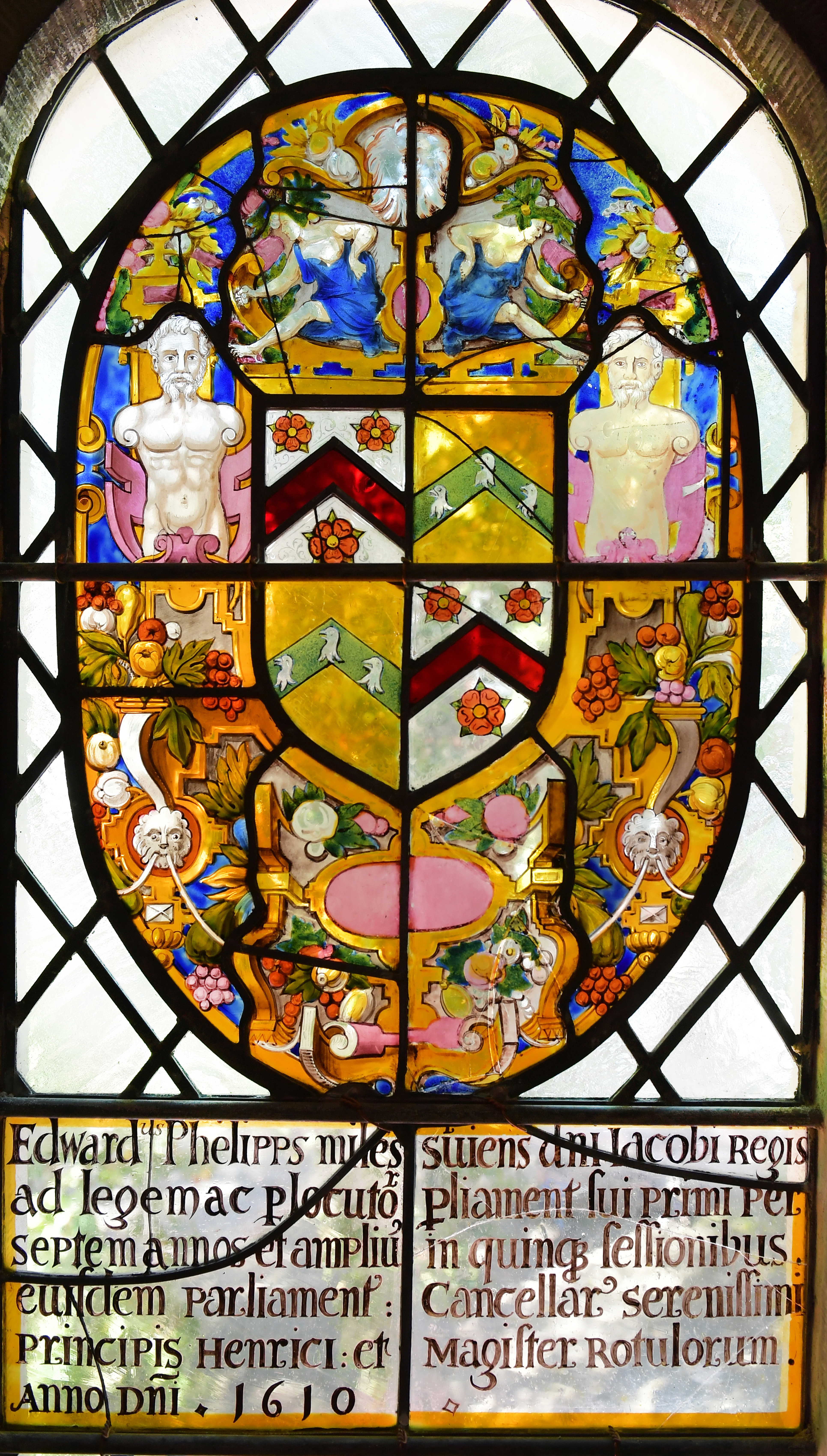
Armorial Glass in Middle Temple Hall of Sir Edward Phelipps
Staging an entertainment as complex and elaborate as a courtly masque was an expensive undertaking, and funds had to be raised from members and Benchers of the Inns. The Middle Temple's Butler, John Hopkins, was tasked with gathering the money, and records survive of his indefatigable efforts on the 'masque rolls'. The expenditure, on everything from satin to stabling, would eventually amount to over £2,000 between the two Inns, at least £400,000 in today's money.
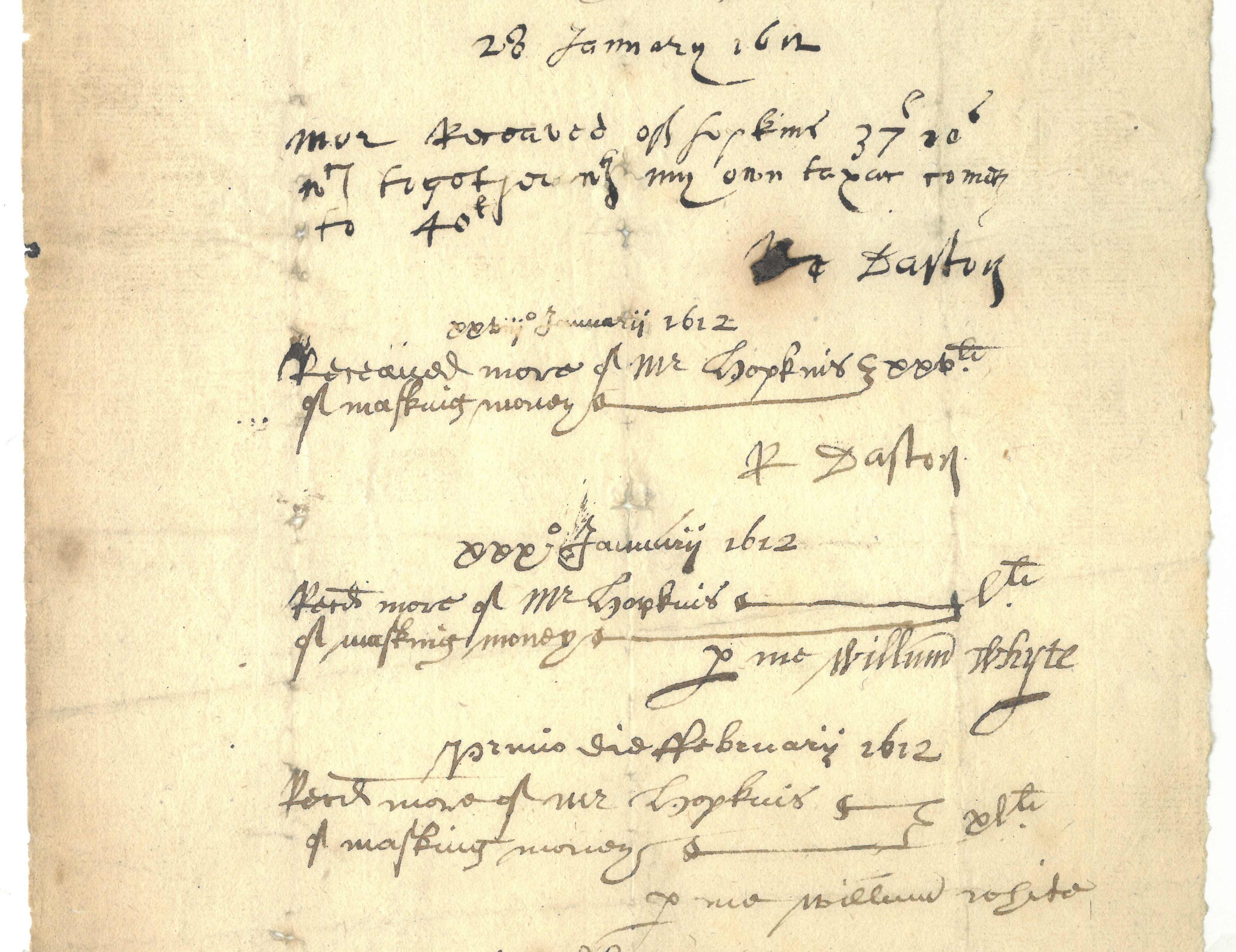
Records of payments from Middle Temple members towards the Masque, January and February 1613 (MT/7/MAA/3)
Several of the creative figures involved were also connected to colonisation, including George Chapman, a scholar, poet and dramatist, who was engaged to write the masque. His work had been performed in London since the mid-1590s and he had written poetry on Raleigh's ventures in Guiana. He collaborated in 1605 with Ben Jonson and the Middle Templar John Marston on the satirical comedy Eastward Ho, which landed him briefly in jail, but by the 1610s he had gained the patronage of Prince Henry.
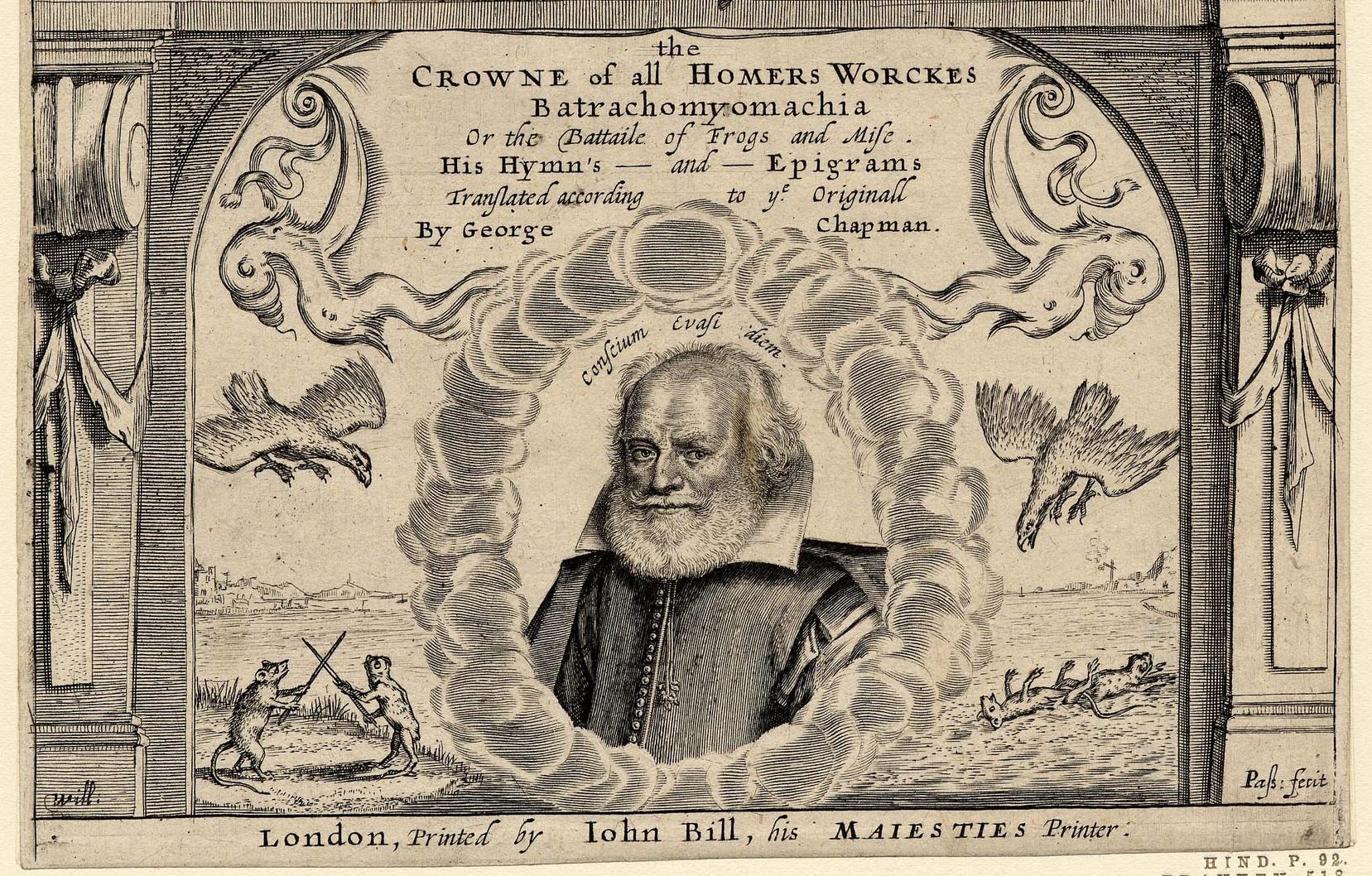
Detail from title page of George Chapman's 'The Crowne of all Homers Worckes Batrachomyomachia or the Battaile of Frogs and Mice', 1624
© The British Museum
Composing the music was Robert Johnson, lutenist to Prince Henry since 1611, who had written accompaniments for plays such as Shakespeare's The Tempest (itself a work with colonial themes). Among the performers were the celebrated composers John Dowland and Thomas Ford, also associated with the court. The scenery and costumes were designed by Inigo Jones, best known today for his architectural landmarks around London and beyond. He had worked on several masques since 1605, and was appointed Surveyor to Prince Henry in 1610.
The Performance
Mid-way through the wedding preparations, disaster struck - Prince Henry died of typhoid in November 1612, a tragedy which almost derailed the nuptials entirely. With the loss of the most committed advocate at court for the Virginia Company's objectives, this opportunity for promotion and propaganda was now of paramount importance. The wedding at last took place on Valentine's Day 1613, and the following day, after months of preparation, the stage was finally set for Chapman's Memorable Masque.
The performers assembled on Chancery Lane, at the house of Sir Edward Phelipps, before traversing the city streets in a procession vividly described by Chapman himself. The parade was led by gentlemen of the two Inns, after whom marched a troop of baboons, 'attired like fantastical travellers'. Chariots followed, festooned in silver and gold and carrying musicians and masquers dressed as 'Virginian' Princes and Priests.
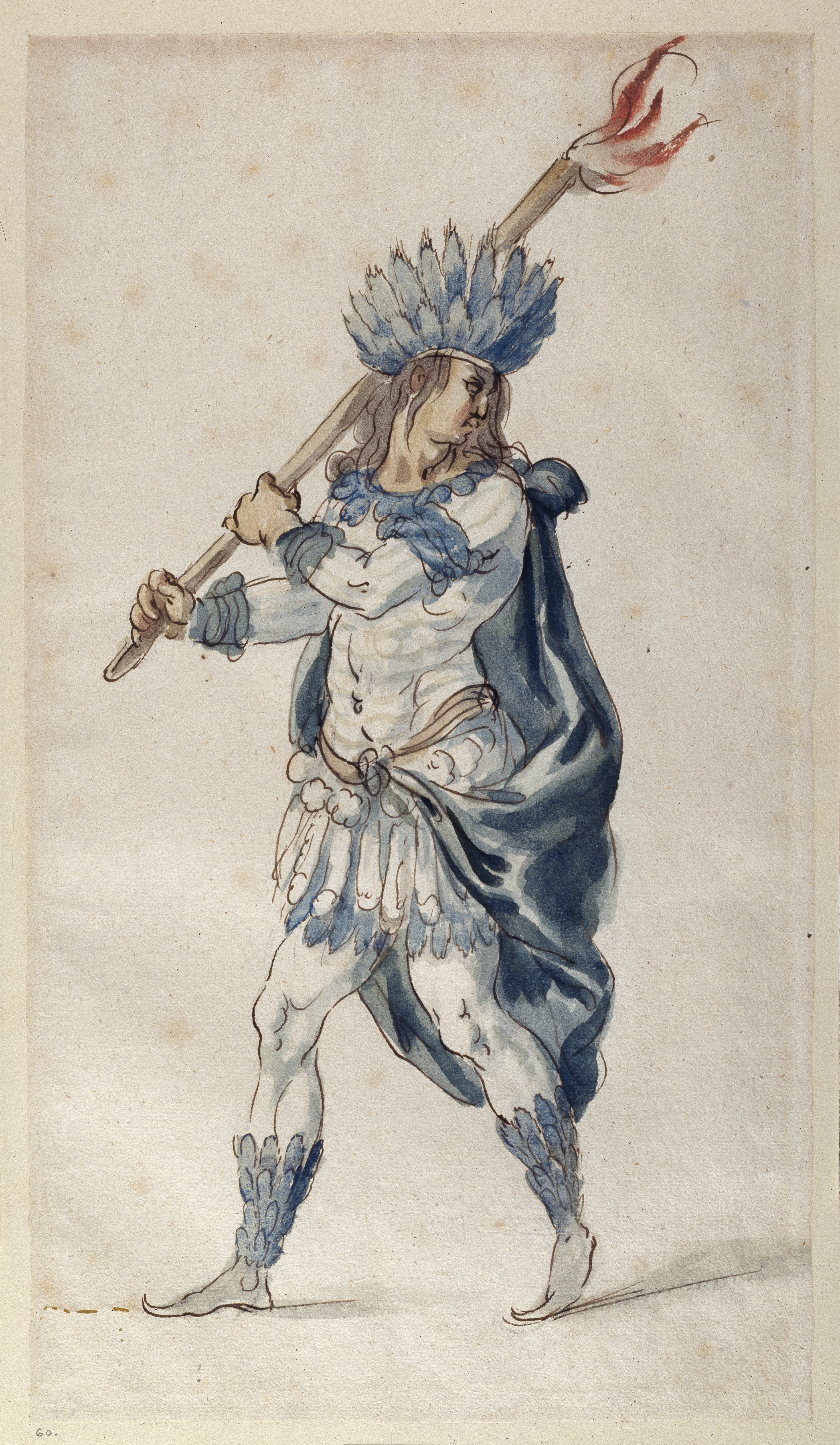
Costume design for an 'Indian' Torchbearer, Inigo Jones, 1612-13
Reproduced by permission of Chatsworth Settlement Trustees / Bridgeman Images
Their costumes, described as 'imitating Indian work', encompassed habits and headdresses, spangled with pearls, ostrich feathers and golden sunbeams. Feathered headdresses were associated in Europe with indigenous Americans, and recent accounts of colonial encounters with peoples such as the Powhatan may have influenced Jones' costume designs. The 'Virginians' in their chariots were accompanied on foot by torch-bearers and African servants were dressed as enslaved indigenous Americans.
In the most richly-adorned chariot rode the leading characters - Plutus, God of Riches, the Goddess Honour and her attendants, and the young wit Capriccio - with an escort of two hundred men armed with halberds (a long weapon ending in an axe-head and spike). In Chapman's words this was 'a show at all parts so novel, conceitful and glorious, as hath not in this land been ever before beheld.'
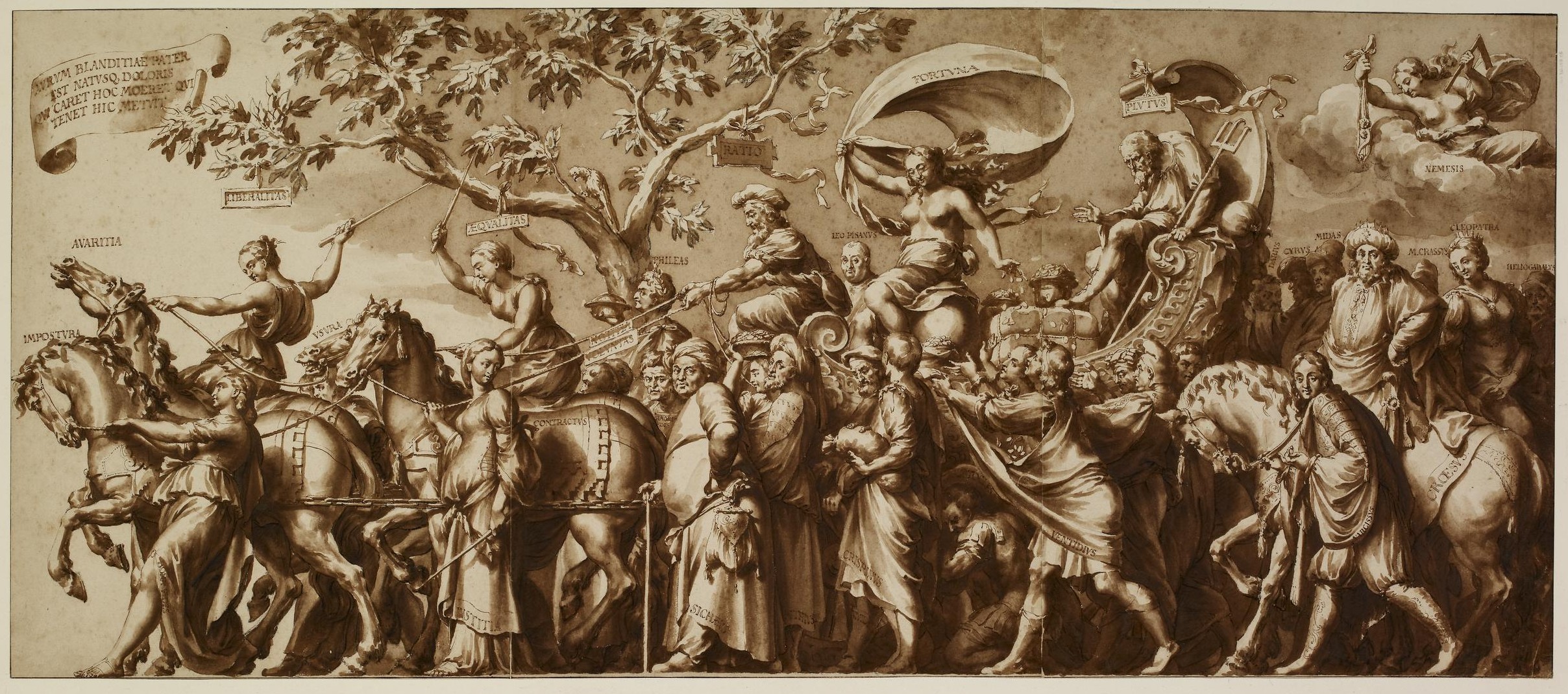
'The Triumph of Riches', showing Plutus on a horse-drawn carriage, Jan de Bisschop after Hans Holbein the Younger, c1628-1671
© The British Museum
Arriving at Whitehall, the procession took a turn around the tilt-yard, observed by the royal family, before entering the Great Hall. Inigo Jones' scenery was dominated by a mountain topped with gold, imagery which owed much to the myths of El Dorado popularised by Walter Raleigh years before, but also echoed the idea of Virginia as a place which promised great wealth.
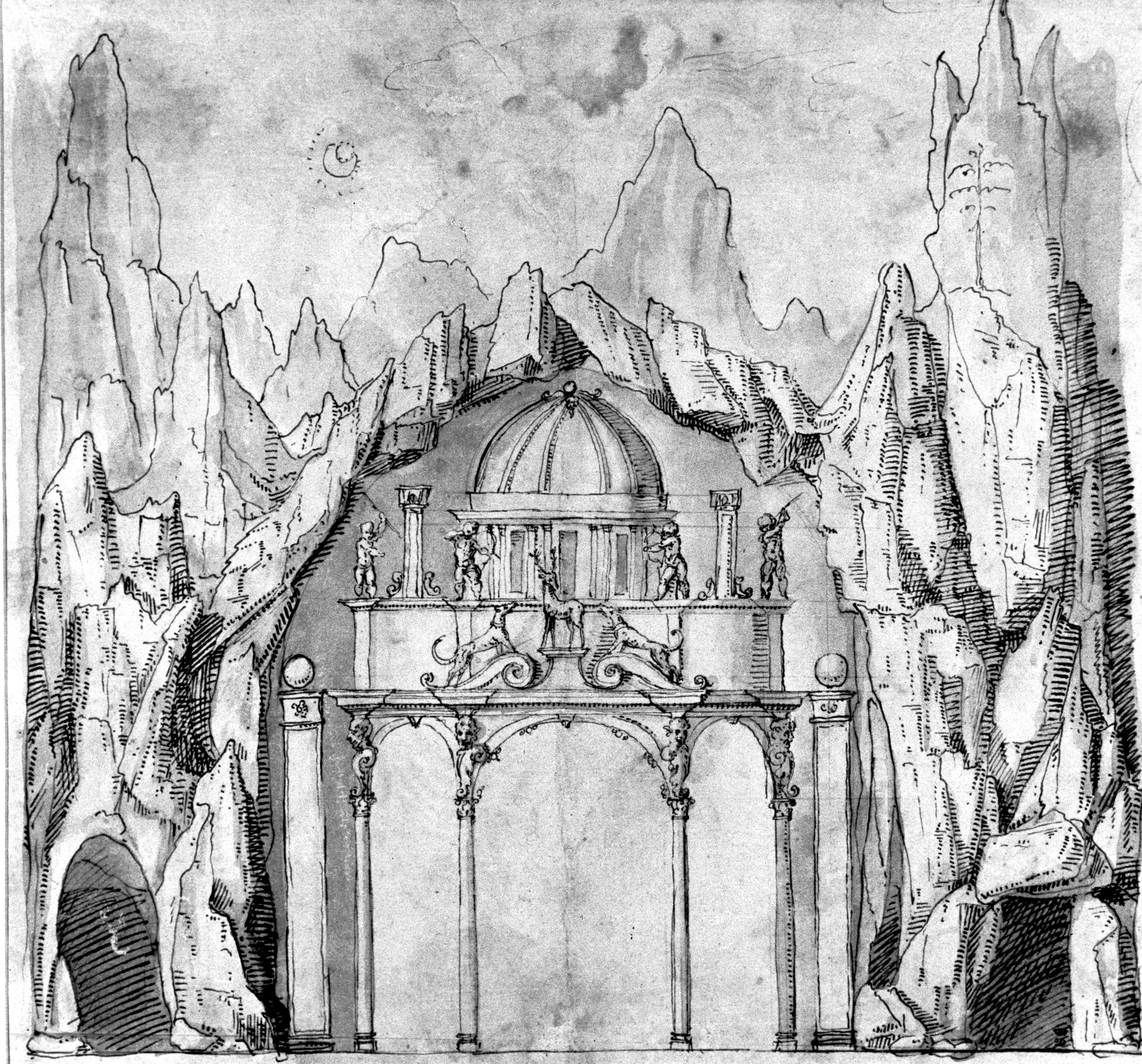
'Palace in a Cavern' (stage design for 'Oberon the Faery Prince' by Ben Jonson), Inigo Jones, c1611
Smith Archive / Alamy
The masque's narrative was rich in complex layers of allegory and symbolism. The story began with the arrival in Virginia of Capriccio, a young 'Man of Wit' in flamboyant costume and in search of wealth, and his encounter with Plutus. As well as satirising the extravagantly dressed young men of the Inns of Court, he represented the naivety of the early colonisers, whose optimistic fantasies of enrichment had met with disappointment and disaster.
While Plutus had traditionally been portrayed as a blind, dull and miserly god, Capriccio was surprised to find him sighted, witty and promising wealth, and the deity ascribed this transformation to his being 'powerfully enamoured' with the goddess Honour. After a performance from his band of baboons, representing the unsavoury individuals attached to dishonourable and profit-driven colonialism, Capriccio was went away with little to show for his efforts.
Honour arrived, accompanied by her priestess and herald, and Plutus paid florid tribute, addressing her as 'Crown of all merit, Goddess, and my Love!' These exchanges and tensions between Capriccio, Plutus and Honour illustrated the friction between the different conceptions of the colonial missions and its objectives.
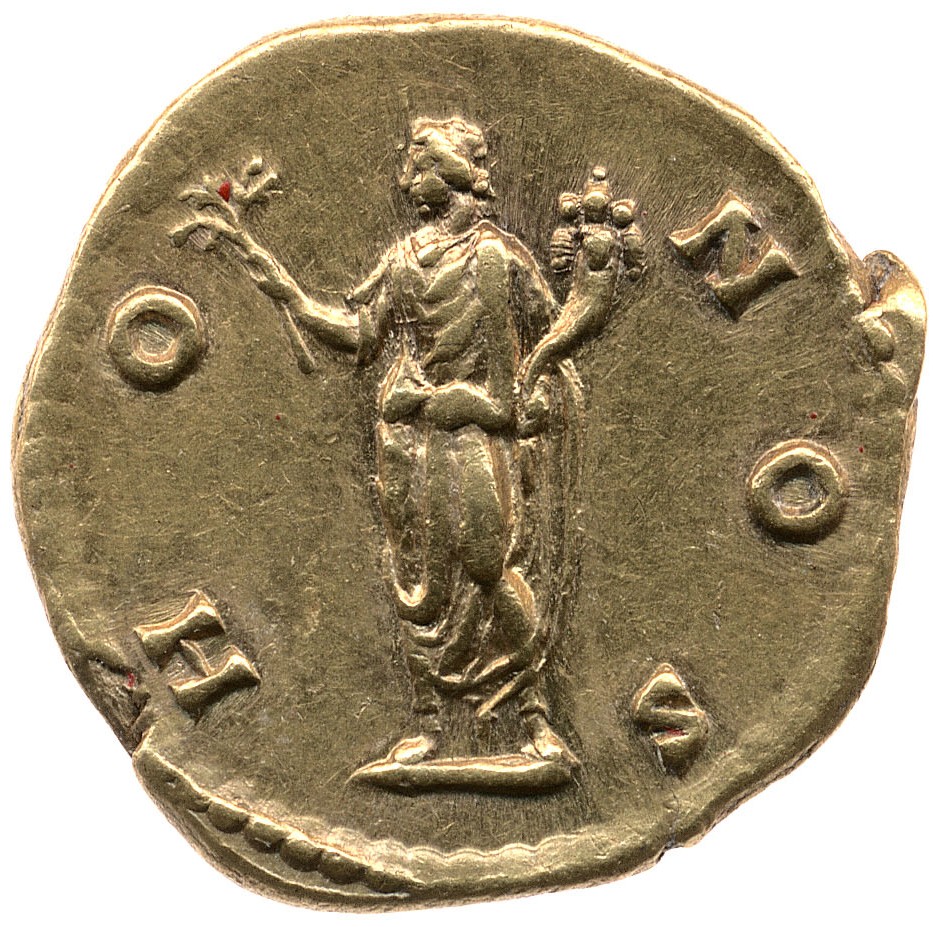
Roman coin from the reign of Antoninus Pius, depicting Honos, Goddess of Honour, 140-144AD
© The British Museum
The golden mountain cracked open, to reveal a 'rich and refulgent mine of gold', and the Virginian Princes seated inside. Above, a setting sun was 'gloriously shining', and the Virginians sang a hymn of praise, accompanied by lutenists. Honour then encouraged them to turn away from such 'superstitious' sun-worship, and instead direct their song first to King James and then to the Christian God, which in turn they did. This scene, reflecting simplified contemporary conceptions of indigenous religious practice, not only illustrated the possibility of converting native populations, but emphasised the fact that, being intertwined with the embrace of the King's rule, such missionary efforts were critical to colonial success.
After further dancing and hymns of 'love and beauty' which paid tribute to the King and the newlyweds, Honour spoke the final words: 'Now may the blessings of the golden age, Swimme in these Nuptials... Now close the world-round sphere of blisse, and fill it with a heavenly kisse!'
What was the moral of the story? By his love of Honour, Plutus was made liberal and bountiful, and the indigenous Virginians turned towards the King and the Christian God. The message was that, while base colonial greed was doomed to failure, if hopes of wealth were married to honourable motives and behaviour - chiefly the spread of Protestant Christianity and British rule, with King James as sponsor and figurehead - then bounty and blessings would follow.
This 'sacred marriage' mirrored and celebrated the royal wedding, and the implication (and hope) was that as King James in his wisdom oversaw one union, he might equally give his wholehearted support and commitment to the other.
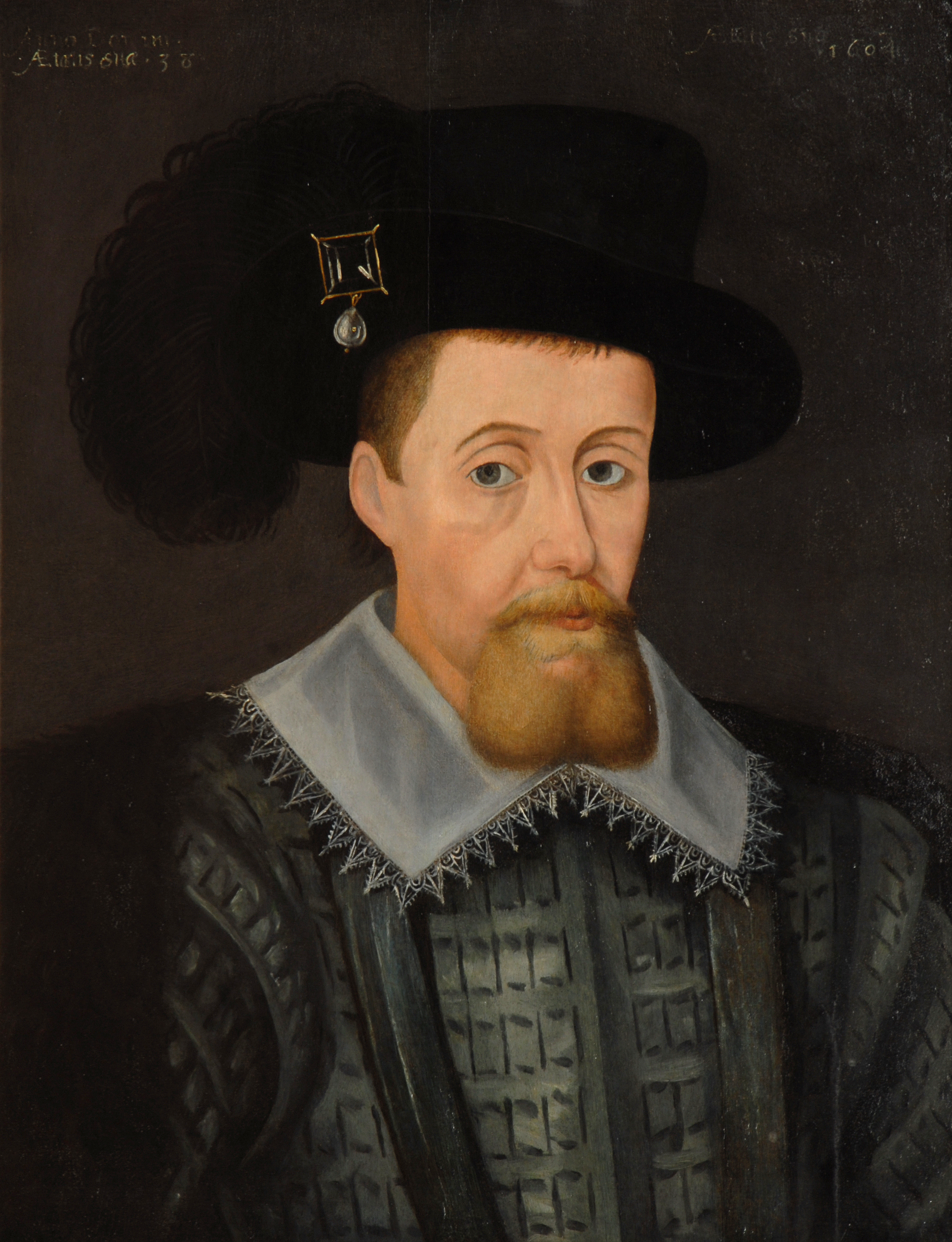
Portrait of King James I, 1604 (P037)
Aftermath
The King is said to have been delighted with the masque, which of course expressed the hopes and priorities of the late Prince Henry, whose presence no doubt lingered in the minds of the sponsors, participants and audience. James communicated his congratulations to the organisers of the masque, which was followed the next day by another staged by Inner Temple and Gray's Inn.
It is hard to say how much the masque influenced royal opinion, but the colony struggled on. Its economy eventually improved thanks to the cultivation of tobacco on plantations which, from 1619 onwards, relied increasingly on the labour of enslaved men and women transported from Africa or taken from the indigenous population. The company itself was granted its 'Great Charter' in 1618, drafted largely by the Middle Templar Sir Edwin Sandys, but by 1623 an investigation into factionalism and mismanagement led to the transfer of colonial authority to the Crown.
Meanwhile, the Inns had run up enormous expenses in staging the masque. Surviving records in the archive of Lincoln's Inn indicate their share of the costs incurred. Inigo Jones was paid £100 for his designs and Robert Johnson £45 for his compositions, while the 'singing men' received £2 each. £65 was paid to the mercer for gold cloth and Flanders satin, and £190 to the haberdasher for 'feathers and trimming of suits and head attires', alongside more mundane expenses such as 6 shillings for the hire of horses and £4 on dinner for the musicians and actors.
Members continued to be shaken down for funds, and the extravagant costumes were sold off. One Middle Templar, Humfrey Peters, was evidently so attached to his 'masquing suit' that he refused to hand it back, and the Benchers were forced to petition Sir Edward Phelipps to compel its return.
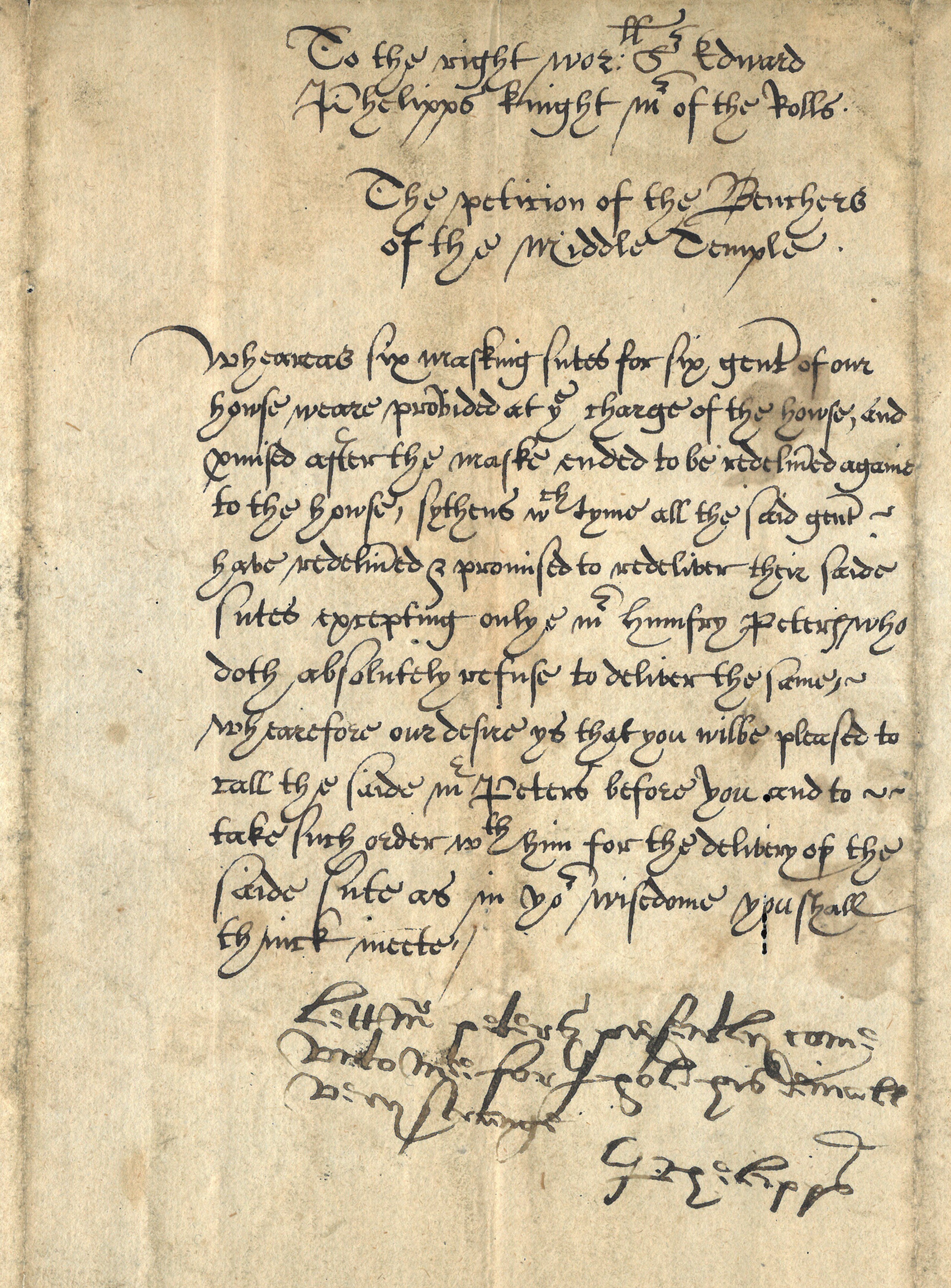
Petition of the Middle Temple Benchers to Sir Edward Phelipps to compel the return of Humfrey Peters' masquing suit, endorsed by Phelipps, 1613 (MT/7/MAA/36)
Inigo Jones was admitted as a member of the Inn, to honour his work on the masque's scenery and costumes. His career went from strength to strength, and he was appointed Surveyor of the King's Works a couple of months later, soon establishing himself as the leading architect in England. Many of his works endure to this day, including the Banqueting House at Whitehall, the Queen's House at Greenwich, St Paul's Church at Covent Garden and Lincoln's Inn Fields. He also designed a monument to his close friend and creative colleague on the masque, George Chapman, who died in 1634, which can still be found in the church of St Giles in the Fields today.
Following the celebrations, Princess Elizabeth and her new husband departed for Heidelberg, and in 1619 they became King and Queen of Bohemia. Their short-lived reign ended with the Battle of the White Mountain in 1620, after which they were deposed and exiled, being remembered thereafter as the 'Winter King and Queen'.
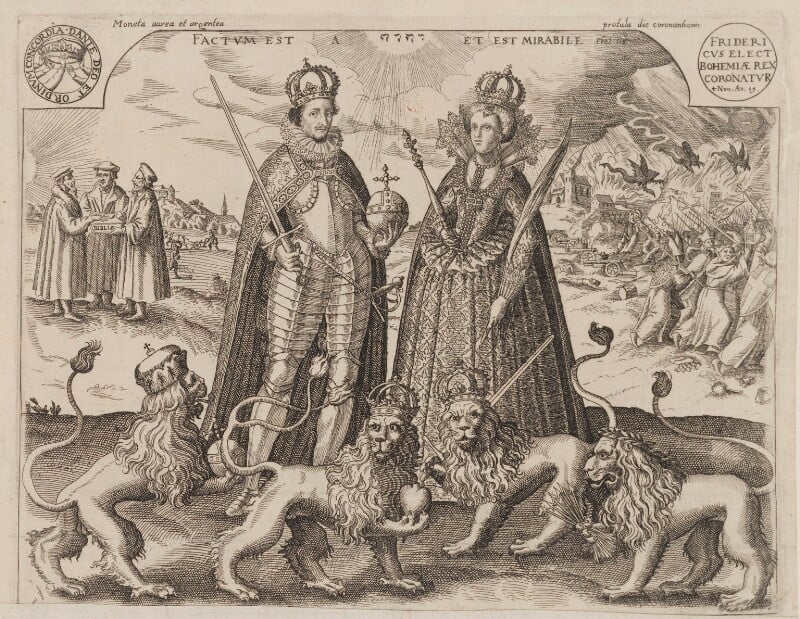
Frederick V, King of Bohemia and Elector Palatine; Princess Elizabeth, Queen of Bohemia and Electress Palatine, etching and woodcut after Unknown Artist, 1619
NPG D9482 © National Portrait Gallery, London
The couple had many children, their twelfth being Sophia, who married the Elector of Hanover. It was her son who succeeded Queen Anne in 1714 as King George I, and his great-grandson, George III, who was on the throne when the Declaration of American Independence was signed in 1776.
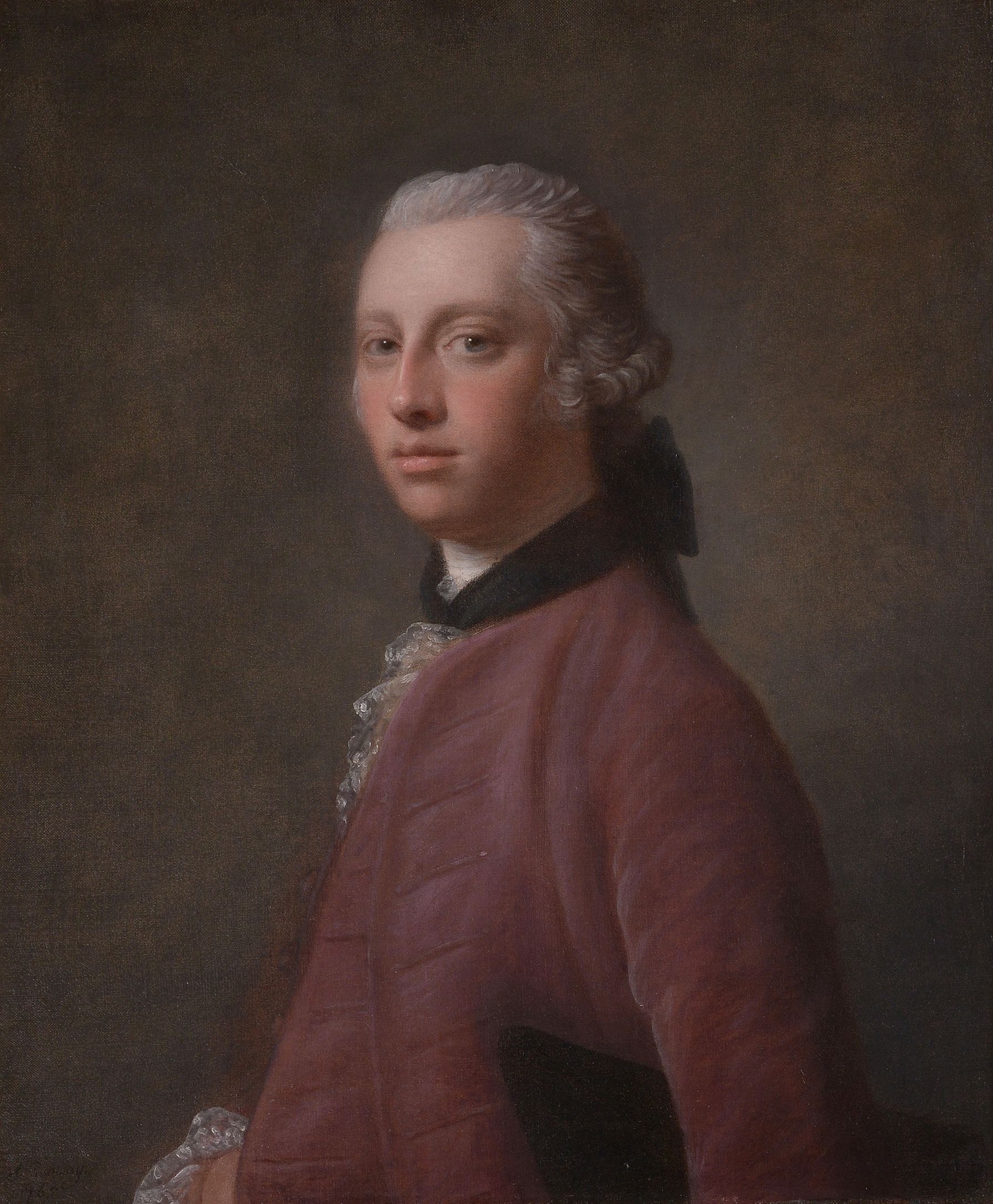
King George III, by Allan Ramsay (P017)
Sources
Crouch, P. (2010) Patronage and Competing Visions of Virginia in George Chapman’s ‘The Memorable Masque’ (1613). English Literary Renaissance, [online] 40(3), pp.393–426.
Working, L. (2020) ‘Wit, Sociability, and Empire’, in The Making of an Imperial Polity: Civility and America in the Jacobean Metropolis. Cambridge: Cambridge University Press (Cambridge Studies in Early Modern British History), pp. 160–198.