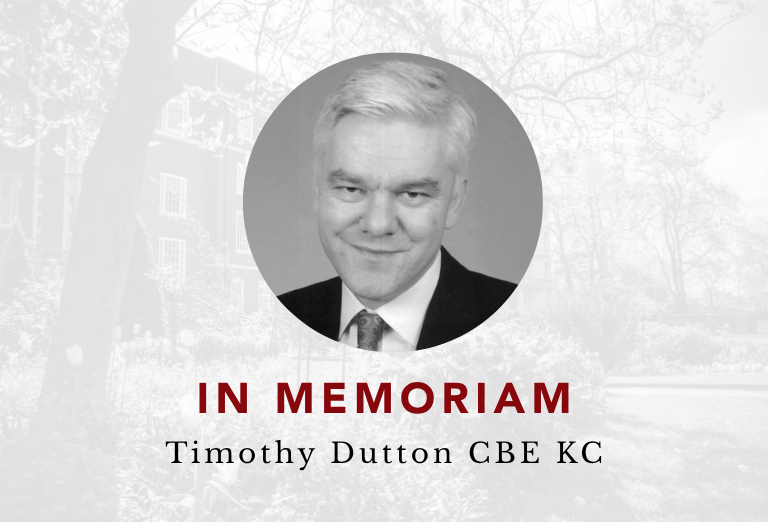
Memorial for Master Timothy Dutton, KC on 4 June 2026 - Eulogy by Edwin Cameron (friend and former member of the South African Constitutional Court)
Tim Dutton was my friend. The huge, distinguished turnout today – family, colleagues, friends, eminent Judges – humbles that claim:
Tim was so much more than just “my friend”.
But I do have a particular claim to his friendship and love – and that is why Sappho, his widow, and Pia, his daughter, have honoured me by inviting these words today.
Tim’s and my lives were cast together in the cold Oxford winter of 1977, after I changed belatedly from classics to law. Tim was fresh from A-levels at Repton; I was on a scholarship from South Africa.
Keble was not then a fashionable college (is it, even now?), which meant I was the only non-Briton reading law.
Thus it was that Tim extended his friendship to me, as we frenziedly prepared our twice-weekly essays in the College’s law library, and then shared tutorials under the austere and unforgiving tutelage of our blind (and brilliant) law don, Jim Harris.
Tim was tall, strikingly handsome, and dazzlingly talented.
He was gifted musically (the French horn his main proficiency), sang beautifully (a gift honed as a pre-pubescent chorister at Durham, and passed on to Pia) – and took leading roles in the College’s amateur productions.
His wit was laconic, and he affected a languorous drawl that could not disguise a deeply sensitive percipience that infused all his interactions.
Soon his invitations embraced me – the very first was afternoon tea in his room in college, with illustrious personalities from the Oxford Union his guests of honour, including Benazir Bhutto, later grievously assassinated, who draped herself across Tim’s window seat and held forth commandingly. I was agreeably intimidated.
A few months later, as the first of my three persistently grey and cloudy English summers unfolded, Tim invited me home.
This, to me, was extraordinary – my first invitation to an English home – and it entailed the excitement of a long train journey up-country, sitting opposite Tim as the countryside swept by, our destination Richmond, in north Yorkshire, where we spent a weekend with his parents, Joan and Derek, in the residence of the Head Master of Richmond School.
The visit gave me a smidgeon of insight into Tim’s profound respect for study and learning, the extent of his literary accomplishments, his unpretending polish in music, song and language (it was from him that I learnt, with a shock of mortification, to say not “recite-a-tive”, but “recitative”).
On the Saturday night, after dinner, when Tim’s parents had retired, he confided, for the first time, a still-recent trauma: his diagnosis, just two years before, in late adolescence, with Type 1 diabetes, which near-catastrophically felled him.
For many weeks he lay in hospital. Thereafter, he was dependent on constant monitoring, rigorous diet control, and innumerable self-injections of insulin.
This early encounter with mortal vulnerability shaped Tim’s life profoundly. It proved to be only his first.
In him it induced a deep humility in the face of fleshly frailty, courage in the face of near-calamity, and a profound engagement with the people around him, and the multiple riches that life offered.
That mortal vulnerability spurred a commitment not only to his practice as a barrister, which flourished glitteringly, powering him to the very top of the Bar in England and Wales, but also to wider public commitments.
These included his and Sappho’s challenge to the crisis of brutality in Burma, through the Burma Justice Committee.
But, apart from his distinguished and productive chairmanship of the Bar, and the many cases he successfully fought, Tim’s greatest impact on the living legal system lay in teaching: teaching advocacy.
This was Tim’s gloriously successful yearly advocacy course, which he hosted at Keble, with significant help from his spouse, Sappho.
Sappho featured at the heart of Tim’s professional successes.
They met in 1983, and married four years later in this very Church.
To Tim, Sappho was a brilliantly clever, occasionally unrestrained, always ferociously outspoken, life companion.
She is herself deeply versed in the law – and thus served as a companion-advisor and helpmeet to him, in his pleadings and opinions and advices; as well as being the mother of his daughter, Pia, who inherited, from her mother, a fierce commitment to justice and equality, and, from her father, the intensely English power of geniality and restraint.
None of this prepared Tim, or Sappho, or Pia, when, at the age of 57, in August 2014, he was diagnosed with his second mortal affliction: motor neuron disease.
It was a stunning reverse, not only for Tim, but for Sappho and Pia, and for Tim’s colleagues and friends and siblings.
At the peak of his professional and personal distinction, this was a deeply wounding blow – one that Tim suffered soberly and matter-of-factly.
Average life expectancy after a diagnosis with MND is two to five years.
But Tim was not average – particularly not in surmounting diagnosis with dread disease; nor in the care that Sappho provided him.
And, as one year stretched into another, as initial disbelief and hope turned into increasingly grievous evidence of decline, Tim’s mere courage, in enduring increasing constriction and disablement and confinement, was tested more and more.
Also tested, sometimes almost beyond endurance, was Sappho.
She, with Tim, made a profound decision: they would not accept or employ outside help.
This meant that Sappho walked every step of the way with Tim. She became his all: his companion, his chef, his researcher, his carer, his nightly comforter when nightmares intruded, his (ferocious) guardian, protector and gatekeeper, his nurse, his bather, and, elementally, his cleaner.
Tim talked to me about dying. He did so because we had another bond: fifteen years before he was diagnosed with MND, he discovered that my body, too, carried a deadly debility. His and Sappho’s tender solicitude to me was unstinting.
There was however a big difference –I was saved from growing debility and premature death by the near-miracle of antiretroviral medications: a stunning research breakthrough.
By contrast, late one night, smoking an indulgent cigar, over a glass of good whisky, Tim quietly made an austere observation.
He noted that, since the major neurological disablements (MND, Parkinson’s, Lewy’s, multiple sclerosis) were described and named in the 19th century, virtually no progress at all had been made in treating any of them.
Tim’s increasing disablement spurred him to more, not fewer, public-spirited interventions. He became an advocate for research into and understanding of MND.
He consented, somewhat counter-characteristically, to being interviewed, for the public good.
When I instigated a controversy on Tim’s home ground, by sharply contesting a senior advocate’s decision to hang onto a brief defending a foreign government’s discrimination against a vulnerable minority, Tim issued a public statement, co-signed by two other Leaders of the Bar (Chantal-Aimée Doerries and Roy Amlot, as well as Baroness Ruth Deech), that demolished the defence sought to be propounded.
In the circumstances, this was an extraordinary act, one that combined truthfulness, courage and profound friendship.
And Tim never ceased being unstintingly generous, not only in his and Sappho’s immoderate gifts, and the honours they secured for their friends, but in sustained and lavish comradeship.
When I met Tim, he was not yet 20. Despite his polish and accomplishments, he had boyish looks, and exuded a boyish air. He never lost those. To the end, his irony, his wit, his dogged pursuit of life, were boyish.
The 17 year-old who faced death from bodily infirmity faced his ultimate frailty, no matter how attenuated, with the inner aspiration of his youth to continued life.
Tim Dutton’s death was intolerably poignant. It was inexpressibly sad: so vital an energy, so rich a power, stilled by the failure of a million neurons.
Today, on the first anniversary of his death, we mark that poignancy with sober recall but we also remember, with joy, all the best qualities that the life of Timothy James Dutton embodied: his unfailing courage, his unparaded integrity, his devotion to what was right, and, most of all, the loving relationships and profound friendships to which our presence here, today, is testament.